

Laboratory/Medical Field
Integrated suppliers of equipment, reagents, and consumables
Constant-temperature water baths are essential instruments for laboratories in academic, research, medical, and industrial settings. They support distillation, drying, concentration, and precision heating of chemical/biological samples.
Despite their utility, improper operation compromises experimental results and safety. Below are standardized protocols aligned with US/UK laboratory practices.
I. Operating Principle
Water baths maintain set temperatures via thermal sensors that regulate heating element power output. Ideal for uniform heating ≤100°C. Multi-well configurations (e.g., 4-well/6-well baths) accommodate concurrent experiments.
II. Primary Applications
Sample heating: Provides stable temperature for tubes/flasks.
Reaction control: Modulates chemical reaction kinetics.
Sample dissolution: Ensures homogeneous heating for solid-solvent mixtures.
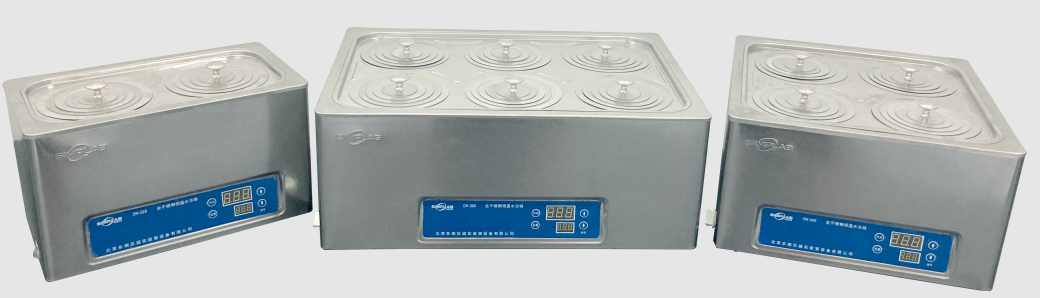
III. Operational Procedure
Fill: Add deionized water to ≥5 cm above shelf, not exceeding 2/3 capacity. Never power on before filling.
Power: Press "Power" button. The heating indicator illuminates if set temperature exceeds ambient.
Set temperature:
Press "Set" button until display flashes.
Adjust with "↑" or "↓" arrows.
Temperature stabilizes within accuracy range after several seconds.
Load samples: Place heat-resistant containers in wells. Close insulated lid.
Shutdown: Press "Power" to deactivate. Unplug.
Post-use: Drain cooled water. Wipe interior/exterior dry with lint-free cloth. Store ventilated area.
IV. Critical Precautions
(A) Maintenance
Storage: Keep in dry, ventilated space. Avoid flammable/corrosive materials nearby.
Power safety: Use 3-pin grounded outlets. Verify earth grounding.
Water integrity:
Prevent flooding control compartment.
Never operate without water ("dry-fire protection" active).
Thermal safety: Avoid contact with U-shaped immersion heaters or heated water.
Post-experiment: Cool to <50°C before draining to prevent scaling.
(B) Routine Inspection
Check electrical contacts for corrosion monthly.
Verify temperature accuracy quarterly using NIST-traceable thermometer.
Remove mineral deposits from wells with 10% citric acid (rinse thoroughly).
Test dry-fire cutoff function biannually.
(C) Troubleshooting Protocols
 Subscription number
 WeChat Mini Program
SimplabCopyright 京ICP备09066698号-16
 EN
EN  CN
CN RU
RU