

Laboratory/Medical Field
Integrated suppliers of equipment, reagents, and consumables
What elements are indispensable in a standard laboratory configuration? Establishing a laboratory—whether new, expanded, or renovated—requires more than selecting appropriate instruments. It demands comprehensive planning encompassing overall layout, workflow design, infrastructure (electrical, water, gas, ventilation, air purification), safety measures, and environmental controls. Below is a breakdown of essential configurations for standard laboratories:
I. Laboratory Benching Requirements
(1) Bench Planning
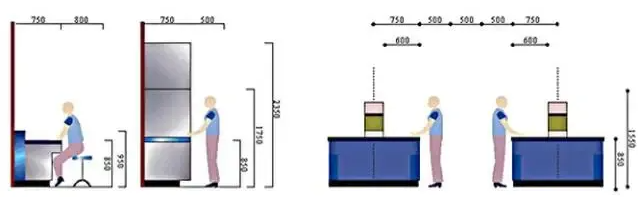
Benches occupy the largest footprint. Clearance standards between benches (denoted as L) are:
L > 500 mm: Allows standing operation on one side
L > 800 mm: Allows seated operation on one side
L > 1,200 mm: Permits seated operation on one side + standing on the other (no through access)
L > 1,500 mm: Seated operation on both sides + central walkway
L > 1,800 mm: Seated operation on both sides + walkway accommodating instrument transport
(2) Bench Surface Classifications
Function-Specific Surfaces:
Chemical-resistant: Resists concentrated acids/alkalis (e.g., 98% H₂SO₄), high temperatures; phenolic resin surface.
Physical testing: Antistatic, thermal/abrasion resistant, stable (e.g., withstands 28% H₂SO₄); fireproof laminate surface.
Biological: Waterproof, antimicrobial; stainless steel surface.
Design Specifications:
Materials: Laminated or solid-core surfaces.
Placement: Instrument/balance benches ≥400 mm from walls. Aisles must connect to corridors for emergency egress.
Structural: Floor-to-ceiling height: 3.7–4.0 m (clear height 2.7–2.8 m). Cleanrooms: 2.5–2.7 m clear height (excluding plenum). Corridor width: 2.5–3.0 m. Door widths: 1.1–1.5 m (double), 0.8–0.9 m (single).
II. Core Configurations by Laboratory Type
1.Cleanrooms
Controlled environments managing particulate count, microbial concentration, temperature, humidity, and pressure.
Air Cleanliness Standards:
China: Class 100/1,000/10,000/100,000 (particles ≥0.5 μm/L)
ISO: Class 1–5
(a) Reagent Storage & Prep Area (Specimen Prep Zone)
Key equipment: Refrigerated centrifuge, biological safety cabinet, refrigerator, mobile UV lamp, dedicated apparel.
(b) Amplification Product Analysis Area
Key equipment: Pipettes, vortex mixer, laminar flow hood, capillary electrophoresis system, refrigerator, centrifuge, mobile UV lamp.
2.Support Laboratories
(a) Balance Room
Houses analytical balances (vibration/sensitive to airflow).
Location: Adjacent to chemistry labs but isolated from high-temperature/EMI sources. High-precision microbalances ideally on ground floor.
No sinks or overhead piping allowed (risk of leaks/vibrations).
(b) High-Temperature & Incubation Rooms
Equipment: Muffle furnaces (on heat-resistant benches), incubators (floor-standing if large).
Critical: Physical separation of furnaces and incubators.
(c) Pure Water Room
Features: Side benches, rinse sinks.
Infrastructure: Deionized water supply, floor drains.
(d) Gas Cylinder Storage
Stores non-flammable (N₂, CO₂) and inert gases (Ar, He).
Hazardous gases (flammable: H₂, CO; toxic: F₂, Cl₂; oxidizing: O₂) piped from external storage only.
Piping: Helium (He), nitrogen (N₂) for GC; H₂/N₂/O₂ for GC-MS. Hydrogen lines: Welded joints, mandatory leak testing. Minimum 45 mm pipe separation. Cylinder cabinets: Segregate flammables and oxidizers.
(e) Solution Preparation Room
Equipment: Fume hood, workbench, reagent cabinets, dedicated balance area.
3.General Chemistry Laboratory
Core functions: Titration, ion measurement, redox reactions.
Key infrastructure: Benches with sinks, fume hoods, reagent shelving, auxiliary workstations, computer terminals, chemical/glassware storage, floor-mounted instruments, emergency equipment.
4.Instrumental Analysis Laboratories
(a) Gas Chromatography (GC)
Function: Separation of volatile organics/gases.
Critical infrastructure: Dedicated instrument bench (service clearance), snorkel exhaust, computer terminal, auxiliary bench, rinse sink.
Environmental: Local exhaust, no direct sunlight, EMI shielding.
(b) Liquid Chromatography (HPLC)
Function: Separation of non-volatile/thermally labile compounds.
Infrastructure: Comparable to GC lab.
(c) Mass Spectrometry (MS)
Function: Molecular weight/structure determination.
Equipment: MS or GC-MS systems.
Critical: Mercury vapor containment (local exhaust mandatory).
(d) Spectroscopy Suite
Instruments: Atomic absorption/emission spectrometers, UV-Vis/fluorescence spectrophotometers, FTIR, XRF, ICP-OES, Raman spectrometers.
Infrastructure: Vibration isolation, dust/chemical/humidity control, local exhaust (atomic absorption hoods ideal).
Placement: Isolated from wet chemistry and radiation sources. Service clearance around instruments.
Note: All analytical labs may include sample prep areas with sinks, benches, and fume hoods.
III. Special Gas Delivery Systems
Distribution limited to non-flammable and inert gases (on-site cylinders). Hazardous gases piped from external storage via leak-tested, oil-free lines with ≥45 mm separation. Flammable gases require welded joints.
IV. Hazardous Exhaust Systems
Critical for removing toxic vapors/aerosols. Evolution of control systems:
Constant Air Volume (CAV) → Dual-State → Variable Air Volume (VAV) → Adaptive Control (optimizing safety/energy efficiency).
Modern approach: Treat entire lab as containment zone, balancing airflow for safety and sustainability.
Exhaust equipment: Fume hoods, atomic absorption snorkels, articulated exhaust arms, ceiling-mounted/overhead canopy hoods.
 Subscription number
 WeChat Mini Program
SimplabCopyright 京ICP备09066698号-16
 EN
EN  CN
CN RU
RU